Tuesday, March 22, 2011

In Dhofar


Dhofar is the southern region of Oman, and is very different from the rest of the country. Salalah, the capitol of Dhofar, was historically never a part of Oman; and since 1,000km of desert separates Salalah from Muscat, the people have much more in common with Yemenis than Omanis. In 1879 Dhofar was “annexed” by the Sultan of Muscat, and it became part of the Sultanate of Muscat and Oman. The people never really became Omani, though. They traditionally don’t speak Arabic, but another Semitic language no one else knows that has more in common with Hebrew.  

The culture in Dhofar is more conservative and tribal than in Muscat. It’s much more common for a man to have more than one wife here, and way more women were in nakab (with only their eyes showing), than I’d seen anywhere else. People’s tribes still determine a lot – social status, who one can marry, who one can be friends with, etc. etc. The tribe is much stronger here than anywhere else in the country, and it affects most aspects of Dhofaris’ lives.

One way the difference between Muscat and Salalah shows itself is clothing. Fashion is way cooler in Salalah – the turbans/massirs and dishdashas men wear are more colorful and vibrant. Also, men here wear the wizzar (a long piece of fabric tied like a towel that is traditionally worn under a dishdasha) as a garment itself – essentially walking around in very stylish underpants. The designs can be really flashy and awesome, and I will definitely be getting a few when I go back to do research.

Because of all this, Salalah feels like a different planet compared to Muscat, but it’s a planet I think all the group likes more. It feels a lot more like a city. Muscat is so spread out and it takes so long to get anywhere that a car is a requirement (or in my case, a taxi). Salalah is much smaller, and a lot more things are within walking distance. Buildings are also taller, and there’s a lot of people out and about. It just has a nicer vibe to it than Muscat, I think. It’s also a lot more historical (the ruins of Khor Rori date back to 300 BCE) and interesting.

Frankincense is huge here. It is everywhere and is an integral part of Dhofari history, identity, and culture. The region is one of only three spots in the world (Yemen and Somalia are the other two) where frankincense grows, and Dhofari frankincense is considered the best in the world. Without Dhofar’s frankincense, Oman’s rich history of maritime trade could not have happened, and Jesus would have gotten one less gift, since most people believe his frankincense was from Dhofar.

We visited other parts of Dhofar – Mirbat (home to a 5-star Marriot with a fantastic swimming pool), Taqah (birthplace of the Sultan), Khor Rori (ancient frankincense port), and al-Baleed (another ancient city, dating past 1329 CE, and famous for its mosques). I’m very excited to go back to Dhofar in April to do research for my capstone project. Before that, though, we’re going to Abu Dhabi, Dubai, and Doha. Some of my goals while I’m in Dhofar are to see the Empty Quarter and go on a real camel ride. Cross your fingers!

Monday, March 21, 2011

The Dhofar Region

 At the beach.


 The whole SIT group.


 More beach.


 Mountain at the beach.


 Outside Taqah, the town where HM Sultan Qaboos was born.


 View of Taqah from a nearby cliff.


 Another view of Taqah.


 Khor Rori. Over the hill is a place known as "the Valley of the Witches". It's closed off and guarded by the government. People feel very strongly about witchcraft here. Many people have experienced things themselves, but everyone has a friend whose cousin's uncle's best friend's roommate, etc. etc. has seen a witch or witnessed very strange events (ropes standing on end, streams disappearing into mountains, etc.).


 View of the town of Sumhuram, a World Heritage site. It was an old frankincense port that dates back to 300 BCE.


 Another view of Sumhuram.


 Ethan and me with Mohammed, our Dhofari friend I will be spending a lot of time with during my research period.


 Ships waiting for access to Salalah Port.


 A ship unloads its cargo in the Port.


 Salalah Port deals with 5 million tons of shipping per year.


 Stopping by the side of the road to drink fresh coconut milk. He literally cut the top off with a machete and put a straw in it.


 Some of the group enjoying their coconuts.


Roadside fruit stands in Salalah. Salalah is known for its fantastic bananas. I ate about nine. They're delicious.


A frankincense tree. Dhofar is one of 3 places in the world where frankincense grows, and it is known to have the best in the world. Frankincense can also be found in Somalia and Yemen.

Friday, March 11, 2011

Bahla


Bahla is an ancient town about a half hour outside Nizwa, in the interior of the country. It is known around Arabia as the birthplace of jinn, or black magic, and it pre-dates Islam. Legends about Bahla’s past involve people being turned into cows or goats and people vanishing when they leaned against certain fence posts. Though it is Oman’s version of Salem, the witchcraft is not something people talk about readily; it is considered part of the past.  (In other words, Bahla’s economy is not driven by tourism or the sale of “I went to Bahla and all I got was hexed” t-shirts.)

Many Omanis, including the University of Nizwa students I lived with and my homestay brothers, have no desire to visit Bahla. Their reactions to our visit included shaking heads, raised eyebrows, and the widely-used “tsk tsk” sound to show disapproval. I was also asked if I saw any jinn and/or if I got hexed (the answer is no). Interestingly, those that had adverse reactions to our visit had never been there. When I showed my brother some of the pictures I took, he was surprised that it seemed like a fairly normal place, and I had to repeat multiple times that we were actually looking at pictures of Bahla.

The part of Bahla I found most interesting had nothing to do with jinn, however. It was the Abulla bin Hamadan al-Adwi Trad Aladawi Clay Pots Factory. Speaking with the old men sitting at the pottery wheels, I found out the factory is over 500 years old. These men accompanied their fathers to work and had been rolling clay and throwing pots since they were little kids. The shortest amount of time one of them had worked there was 40 years. Though they spoke the Omani colloquial Arabic very quickly, from what I could understand their families have been potters for centuries.

In my opinion, the factory serves the people of Bahla before it serves tourists. The men were spinning giant pots (about 3-4 feet tall) for date collection, something useful for residents of Bahla and not easily transported on a plane. Because of its age, tradition, and the fact that it contributes to Bahla the same way it has for centuries, I think the factory was the most “authentic” part of Oman I’ve seen yet. Let me explain.
In some of the souks in Muscat, you’ll find people from India or Pakistan selling khanjars (a traditional decorative Omani dagger) and dishdashas (traditional Omani dress). Though there’s absolutely nothing wrong with that, there’s also nothing “authentic” about it – it’s a business. From my perspective, there’s something artificial about a non-Omani that doesn’t speak Arabic selling traditional examples of Omani heritage. Think of a Civil War reenactment made up of German tourists...not exactly the spitting image of Gettysburg. The pottery factory has catered to tourists only by establishing an un-staffed gift shop. Its main purpose is still to make pots.

All in all, Bahla was worth the trip. To top it off we spent 800 baisa (around $2) for giant fresh fruit smoothies. Juice in Oman is like juice nowhere else. The one generalization I’d be comfortable making about this country is that all its juice is delicious. Every glass I’ve had, be it from the grocery store or a corner coffee shop, is fantastic.

Nizwa and the Interior

Walking towards the ruins of old Birkat al-Mouz, the town where the University of Nizwa is located.


Carefully exploring the ruins in the very hot sun.


Walking in a date oasis in Birkat al-Mouz.


Goats hijacked our picnic on our way up Jabal Shems, the tallest mountain in the Gulf region...stupid goats..


View from the top of Jabal Shems.


 Lots of tiny fish nibbled the dead skin off our feet at a spring outside Muscat (for free).
 

 Me, enjoying the fish on my feet.


 A massir-tying session with our student hosts at the University of Nizwa.


A small part of Nahla Fort in the city of Nahla. It took 3 pictures to capture the whole view of the fort.


View from the East Tower of Nahla Fort.


View across Nizwa Fort with a mosque in the background.

Sunday, February 27, 2011

Facts on the Ground

Hi everyone,

You may have seen Oman in the news, with insinuations that it's going to be the next Libya. That's not the case. While we don't know what the next few days will bring, we are doing fine and adapting to changing circumstances as we need to.

No one had heard of Oman before this week (a slight exaggeration), so please take everything you read with a grain of salt. No news story will capture the picture fully and/or accurately.

We're fine, and I'll keep everyone posted. 

Saturday, February 26, 2011

Sharqiyyah Part II: Wadi Shab Photos

 Entering the wadi.


 Channeling our inner mountain goat.


 Still climbin'...


 Canyon wall.


 Water!


 Getting a bit wiped out.


 View from the bottom.


 Deep in the wadi. In the shadow of cliffs.


In the cave. I'm about to swan dive off a waterfall.


 More water.


View from high up.

Sharqiyyah Part II: Wadi Shab


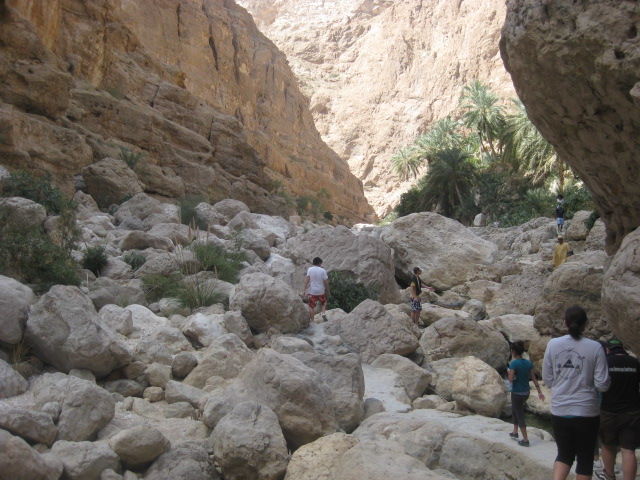
A wadi is a sort of valley with pools of water running throughout it. Some are very river-like, but Wadi Shab was fairly broken up into pools separated by a few steps of rock. The group hiked about an hour until we were fairly close to the end of the valley. The climb was steep, difficult, and beautiful. A wrong step at almost any time would have resulted in a pretty serious fall, so everyone was watching out for each other, helping people get up/off rocks, etc. It was an exhausting hike, and we were all ready for a swim by the end (especially in the 75-80 degree weather).

Once we finally stopped and decided to swim, we went deeper and deeper into the canyon until we reached what seemed like a rock wall. It was actually where two giant rocks came as close to touching as possible without actually touching. We had been told you could get through and that there was a waterfall on the other side you could climb up and jump off, but you just had to get through, first. Single file, we slowly swam between the cliffs, and if I had a really fat head, I couldn’t have done it – it was that narrow. Even though I knew we could get through, I definitely got a bit antsy/claustrophobic (especially since I was the first one through).

Once we all got in, though, it was amazing – a small hidden cave, maybe 30-50 feet across with a waterfall coming down on one side. It was virtually a private room that could only be accessed by swimming through the cliffs and even though sunlight poured in, it was most likely invisible from all other angles. Lucky for those of us that made it through (it was not the whole group), somebody brought their waterproof camera, and we have some pictures that do some justice to the place. Without her camera, there would be no proof that people can swan-dive off a waterfall without selling Old Spice Body Wash. (Pictures soon!)

I’ve never swam in water like that of the wadi. It was completely still (no current or waves); crystal clear or a beautiful blue; and had an almost schizophrenic way of changing depths – one step you’re up to your knees, the next to your ankles, the third to your neck. And though the water was as still and warm as a bath, one had to be able to swim to go where we did. The 50-60 yards (approx) before reaching the passage through the cliffs were opaque and deep, as was the passage itself, and inside the cave. It was an extremely easy swim, however, because of the lack of currents/waves.

The hike back didn’t seem to take as long, since we knew what we were doing, but it was a bit harder than on the way in. (What’s that they say about running only half the distance you think you really can because you have to run back?) My wet-feet/lack-of-socks combo didn’t help anything, either.

All is well, though! I spent the weekend camping in the mountains with a cousin and some other family members, which was unlike any camping experience I’ve ever had, aside from tents and campfire. A very wonderful time with equally wonderful people, though. Sadly, my sunburn-free experience is over. I officially went 29 days in the Middle East without getting sunburn, which may be an Irishmen’s record. The mountains of Jebel Akhdar had other plans, though.

We’ve got our Arabic midterm this week, then we’re off to the interior, Nizwa, for 5 days, living with students at the University of Nizwa. My friend and I went with our Arabic professor to get fitted for our own custom dishdashas and koumbas, because the interior of the country is more conservative than Muscat. (Our professor went to the University of Nizwa and said we’d fit in better there if we were wearing them.)

Pictures on the way!